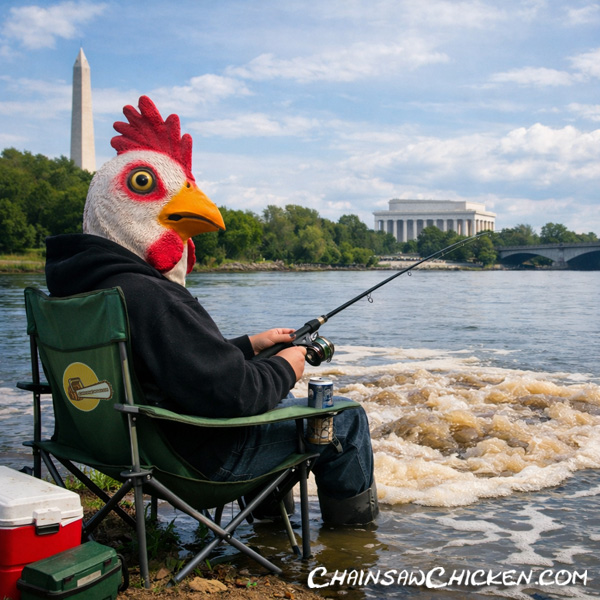
Chainsaw chose the location with care, research, and a folded brochure he found in a glove compartment three years ago.
“This,” he said, planting his lawn chair with conviction, “is exactly where Washington crossed the Potomac in that famous painting.”
He pointed at the river with authority.
The river responded by foaming.
He adjusted his chair so he would be facing history directly in case it happened again.
The tackle box went on the left. The cooler went on the right. The sandwich was temporarily demoted to rock status and later restored. Chainsaw believed in orderly campaigns.
He cast his line into a thick tan blossom near shore that rotated slowly like a decision being reconsidered.
“Strategic current,” he noted.
He scanned the water carefully.
Not for fish.
For coins.
“Washington tossed a lucky coin before the crossing,” he explained to a passing leaf. “Leaders did that back then. For morale and accurate change.”
He kept a watchful eye for flashes of metal between the bubbles and drifting foam clusters shaped like failed meringue.
The smell rolled in — dense, layered, and educational.
Chainsaw sniffed thoughtfully.
“Probably a historical smell,” he concluded. “From reenactments.”
He checked the shoreline.
No other fishermen. No boats. No photographers. No gift shop.
“Nice when a place hasn’t been discovered yet,” he said.
A large bubble surfaced and burst with the confidence of a long speech.
“Cannon echo,” Chainsaw said quietly, respectful.
His bobber tilted, sagged, and partially melted.
“Acidic minnows,” he diagnosed.
A park ranger vehicle slowed on the road above, paused, and then accelerated away like it remembered an appointment in another county.
Chainsaw waved.
“Must be guarding the upstream museum.”
He leaned forward and peered into the swirling water.
“If I find that coin,” he said, “I’m putting it right back. For tradition.”
The foam shifted color slightly, as if reconsidering its lifestyle.
Chainsaw put on a second hoodie against what he believed was “early humidity.”
After an hour he packed up, satisfied with the outing and with history.
“Good to see they’re keeping it authentic,” he said. “Not overdeveloped.”
He left with no fish, one compromised bobber, and deep respect for Revolutionary War recycling practices.
The river continued crossing itself.