The Day I Won a Hundred Terrible Records (and One That Saved Me)
I was thirteen, all elbows and curiosity, tuned to a local AM station that sounded like it was broadcast from inside a coffee can. Every hour they ran a “Name It and Claim It” challenge: be the first caller to identify the mystery song, and you win… something. I had no plan besides a finger on the rotary dial and a heart full of optimism.
I nailed it. Right title, right artist, breathless address exchange with a DJ who called everyone “buddy.” The prize? A stack of one hundred 45 rpm records. To a kid without a driver’s license, this was the equivalent of a used car with a full tank.
The Prize
They handed me the treasure in a paper box that smelled like dust, paper sleeves, and a hint of old basement. The haul was a museum of forgotten ambition: regional singles that never quite made it past the county line, crooners who sang like they were reading a weather report, garage bands recorded in an actual garage. There were sax solos that never ended and love songs that never began. If hope could be pressed to vinyl, this was it—hope and a gentle warp.
Ninety-nine of those records were proof that America has always been brave enough to try. I played them all, like a curator cataloging a lost civilization. I learned things. Like how there are at least seven ways to rhyme “baby” with “maybe,” and none of them should be encouraged.
The One
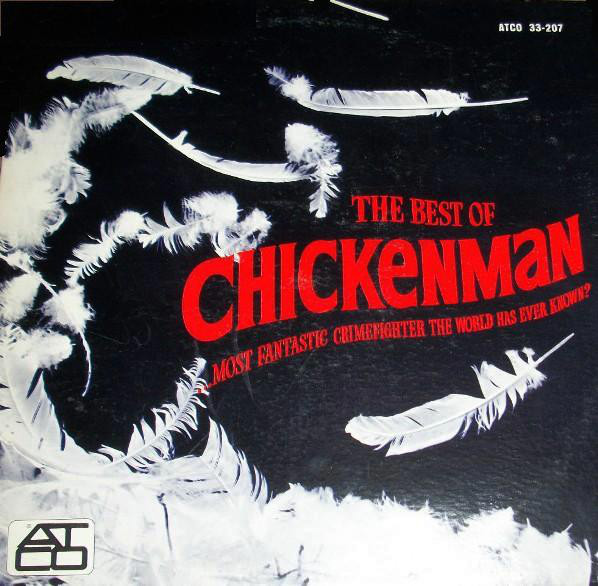
At the bottom of the stack—stuck to a paper sleeve like a secret—was the record. A simple label, no glamour. I dropped the needle, heard a crackle, and then the world tilted.
It was a cut from a radio serial about a caped crusader who wasn’t so much super as sincerely determined. A straight-faced announcer, a sonic wink, a city in need of saving, all packed into a burst of audio theater that felt like it had been smuggled out of a funnier universe. And then the line that detonated in my ribcage:
“He’s everywhere! He’s everywhere!”
That was it. Six words. A catchphrase shaped like a door key.
What It Did to My Brain
That little disc taught me that comedy doesn’t always need a stage light—it can happen in the dark, in your head, built out of voices, timing, and a brass section that sounds dangerously caffeinated. It taught me that tone is a superpower. You can aim dead serious… and still be hilarious. You can wear the uniform of the superhero and reveal the cranky human underneath. You can make a city out of sound effects and a hero out of a pause before the punchline.
It also taught me about economy. A two-minute story can be a complete world if the edges are sharp enough. You don’t need to show the monster to make people see it; you just need to make the hallway creak.
The Lesson I Kept
If you’ve ever wondered why Chainsaw Chicken walks the line between sincere and ridiculous, between straight-on heroics and a wink you can almost hear—it’s because of that record. It gave me permission to take the form seriously and the self lightly. To honor the frame and graffiti the inside. To let the announcer announce and the joke do its job without stepping on it. It taught me that parody isn’t theft; it’s a mirror angled just so.
And maybe most important: it proved that voice can be a costume. You can put it on, and you’re suddenly braver, taller, or at least funnier. That’s a dangerous gift for a thirteen-year-old with a turntable and a long afternoon.
Listening Forward
I didn’t keep all hundred 45s. Some I traded. Some I played into a gentle, merciful silence. But that one stayed—mentally, if not physically. The needle drop is still with me every time I write a headline that sounds like a trumpet or build a sentence that lands like a cymbal crash. When a story opens with a straight face and a sideways grin, that’s the groove I’m chasing.
People ask where Chainsaw came from. I could say “childhood,” “Oregon,” or “poor impulse control,” and none of that would be wrong. But if you want the short answer, here it is: a secondhand 45 about a caped do-gooder and a city that secretly wanted him to succeed. Or fail spectacularly. Either way, there was music.
For the Record (Pun Always Intended)
This is a review of a feeling as much as a record: a salute to the art of the short, sharp, sonic story. If you seek it out, do it the right way—listen through legitimate releases, give the original artists their due, and let the announcer have that perfect pause before the laugh. I can’t give you the exact crackle of my bedroom turntable at thirteen, but I can give you this: the permission slip I got that day.
Be brave. Be brief. Be funny. And remember: the good ones are still everywhere—you just have to drop the needle.